Why the WPA Is a Different Conversation
The Woomera Prohibited Area covers roughly 122,000 square kilometres of northern South Australia — an area larger than England. It is the primary land-based test range for the Australian Defence Force and, under a co-existence framework introduced in 2014, it is also open in part to resource exploration and production.
Access is governed not by the Mining Act but by Part VIB of the Defence Act 1903 and the Woomera Prohibited Area Rule 2014. The practical consequence is that an explorer holding a valid SA exploration licence still cannot enter the WPA without a separate Defence-issued permit, and the conditions of that permit are written around weapons testing schedules, not drill plans.
The Co-Existence Framework in Brief
Before 2014, access to the WPA for non-Defence users was managed case-by-case under the Defence Force Regulations 1952. The Hawke Review and the resulting Defence Legislation Amendment (Woomera Prohibited Area) Act 2014 introduced a transparent permit system and the now-familiar Red/Amber/Green zoning. The objective was to give Defence priority of use while providing resource companies with a defined — if conditional — pathway onto the range.
An independent panel reviewed the framework in 2018, with recommendations implemented through subsequent amendments to the WPA Rule. The Senate Foreign Affairs, Defence and Trade Committee report sets out the legislative structure in detail. Three points carry the scheme:
- Defence retains absolute priority of use — non-Defence access is always subordinate to operational requirements
- Access is zoned according to the frequency and intensity of Defence use, not the prospectivity of the ground
- Certain pre-2014 users — Indigenous groups, pastoralists, rail operators, and four existing mines — retain their access rights under the Defence Force Regulations 1952 and are outside the permit framework
The Four Zones — and What Each Allows
The WPA is divided into four zones based on the pattern of Defence use. The zone determines whether access is available, and how often it is interrupted by exclusion periods. The analysis set out in the Finlaysons review of the 2019 framework changes provides useful background.
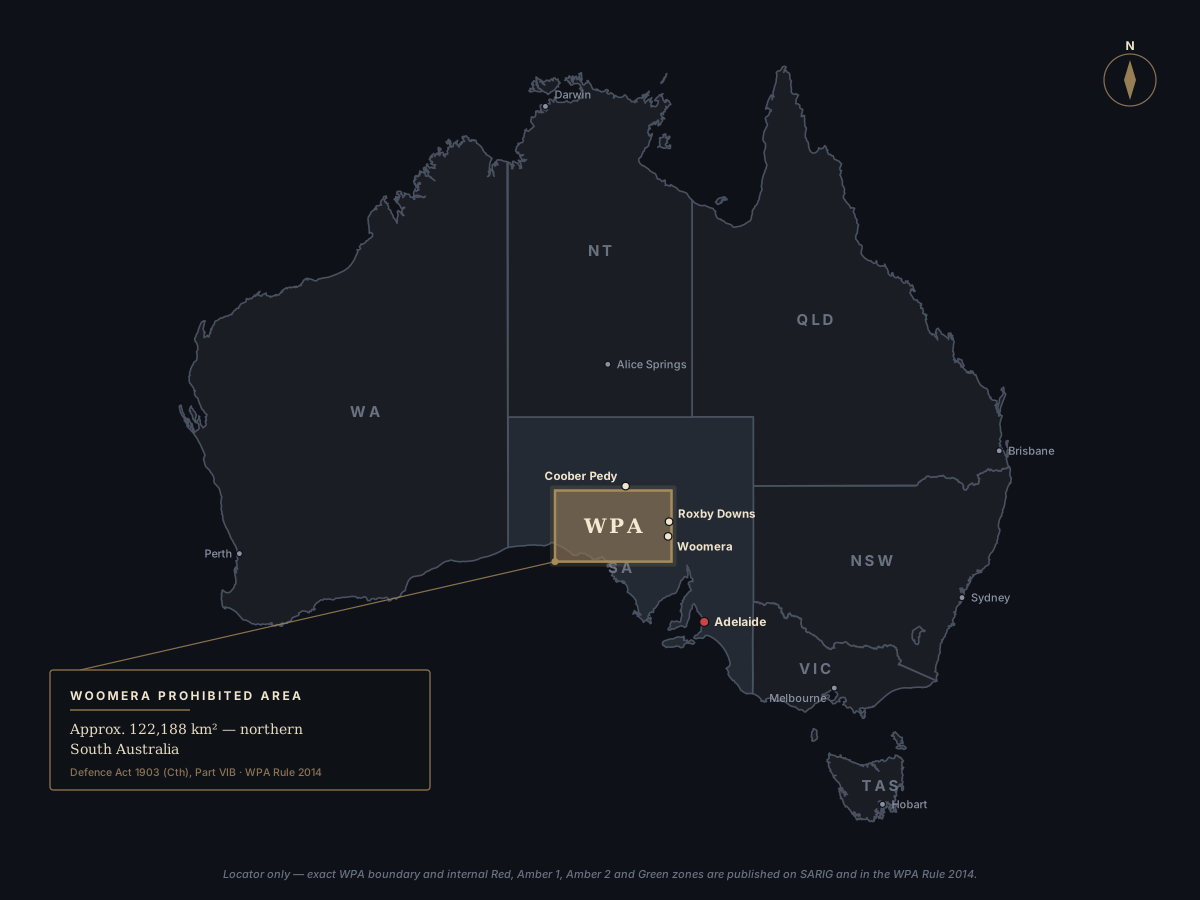
Locator only — not to scale. The exact WPA boundary and the internal Red, Amber 1, Amber 2 and Green zones are published on SARIG and in the Woomera Prohibited Area Rule 2014. Pre-2014 users including Olympic Dam, pastoral lessees, and the Trans-Australian Railway operator hold access rights under separate grandfathered arrangements.
| Zone | Defence Use | Non-Defence Access |
|---|---|---|
| Red Zone | Continuous, uninterrupted Defence use | No new non-Defence users; no new mining or exploration permits |
| Amber 1 Zone | Periodic heavy Defence use | Access available subject to exclusion of up to 140 days per year |
| Amber 2 Zone | Periodic Defence use | Access available subject to exclusion of up to 70 days per year |
| Green Zone | Infrequent Defence use | Presumption of access; exclusion of up to 56 days per year |
The exclusion periods are not worst-case estimates — they are the maximum days per financial year for which Defence can require the zone to be cleared. The Amber schedules are published each March for the coming financial year, which means a programme designed in January has a defined window to plan against. Short-notice adjustments do occur but are comparatively rare and typically tied to scheduled test campaigns.
days closed
max excluded
max excluded
max excluded
Bar length shows maximum exclusion days as a proportion of the 365-day financial year. Actual exclusion schedules are published each March for the coming financial year. Green Zone access is presumed; Amber zones require planning against the published schedule.
"The Red Zone is closed to new non-Defence users. Everything else is negotiable — but on Defence's calendar, not yours."
The Permit System — What You Actually Apply For
The Department for Energy and Mining summarises the permit classes that matter for resource work. The WPA Coordination Office (WPACO), on 1300 727 420, is the administrative point of contact. The Woomera Test Range is on 1300 972 335 or +61 8 8674 3370 for operational matters.
- W001 — Resource Exploration Access Permit. Issued for up to 7 years. Permits an exploration company to access and operate on a defined tenement area within an Amber or Green zone. Prerequisite: a granted SA exploration licence under the Mining Act 1971.
- W002 — Resource Production (Mining) Access Permit. Issued for up to 10 years. Permits mining operations on a defined tenement within an Amber or Green zone. Prerequisite: a granted SA mining lease.
- W003 — Approved Person Status. Individual authorisation enabling personnel to enter and move through the WPA under an existing permit without continuous escort.
- W004 — Escorted Person. Time-limited authorisation for personnel who have not obtained Approved Person status — typically visitors, contractors, or short-duration support.
- W007 — Access Form. Per-entry notification lodged with the WPACO Secretary at least 10 business days before entering the WPA. Required every time personnel or equipment cross the boundary.
Notice Periods — The Numbers That Drive the Schedule
The WPA Rule 2014 sets out the notice periods Defence must give of exclusion events, and the notice period proponents must give of each access event. Both matter for programme planning.
- Annual Amber schedule: published in March each year for the coming financial year, setting out the exclusion days for Amber 1 and Amber 2 zones
- Amber exclusion notices: minimum 3 months' notice of any specific exclusion period
- Green Zone exclusions — resource production: minimum 6 months' notice
- Green Zone exclusions — other users: minimum 21 days' notice
- W007 access notification: at least 10 business days before entry, to the WPACO Secretary
Programme planning inside the WPA is therefore built backwards from the published Amber schedule. A drill campaign targeted for October has to be scoped in March, the W007 lodged 10 business days before mobilisation, and contingency built in for the Amber days that overlap the planned window.
How WPA Permits Work With SA Mining Act Obligations
A common misconception is that a W001 substitutes for, or supersedes, the SA mineral tenement. It does not. The WPA permit framework operates in addition to — not in place of — the standard SA regulatory stack. Three separate instruments must align before a drill bit can turn in the WPA.
| Instrument | Source of Law | Regulator |
|---|---|---|
| Exploration Licence (EL) or Mining Lease (ML) | Mining Act 1971 (SA) | Department for Energy and Mining |
| EPEPR / PEPR | Mining Act 1971 (SA) | Department for Energy and Mining |
| W001 / W002 Access Permit | Defence Act 1903 (Cth), Part VIB & WPA Rule 2014 | WPA Coordination Office, Department of Defence |
| Heritage Clearance (s23) | Aboriginal Heritage Act 1988 (SA) | Aboriginal Affairs & Reconciliation, SA Attorney-General's Department |
The SA tenement must be granted, or well-progressed, before a W001 application will be accepted — DEM's grant decision is a precondition, not a parallel process. Heritage clearance runs alongside both and is not discharged by either. For operators new to SA, the four-instrument stack can add six to twelve months to a conventional exploration timeline if the work is not sequenced from the outset.
Defence Coordination — The Day-to-Day Interface
Once permits are in hand, the day-to-day interface is operational rather than administrative. Each access event must be notified to WPACO and cleared against the Defence activity calendar. This means:
- A nominated WPACO liaison for the programme, with a direct line to the Woomera Test Range operations desk
- Daily or weekly check-in protocols during active field work, covering personnel on-range, vehicle movements, and planned activity
- Clear stand-down procedures for any short-notice range activation, with pre-agreed muster points and evacuation timings
- Strict controls on the use of UAVs, radio communications, and any equipment capable of emitting electromagnetic signatures in range airspace
- A safety induction for all personnel covering unexploded ordnance (UXO) awareness, particularly relevant in portions of Amber 1 that have seen sustained test use
Defence does not charge access fees for resource users, but it does require the proponent to carry the operational burden of coordination. Programmes that treat WPA access as a one-off paperwork exercise — rather than an ongoing operational relationship — are the ones that run into conflict with range scheduling.
Pre-2014 Users and Grandfathered Rights
Not every current user of the WPA is covered by the W-series permit framework. Indigenous Traditional Owners, pastoral lessees whose leases lie inside the declared area, the Adelaide–Darwin railway operator, and four existing mines (the most significant being Olympic Dam) retain access rights under the earlier Defence Force Regulations 1952. These grandfathered arrangements are preserved by the 2014 legislation and continue to be administered separately. For new entrants — and for any new ground targeted since 2014 — the W-series permits are the only pathway.
The practical consequence is that a WPACO search against an area of interest may return several overlapping access regimes, with the new-entrant permit alongside pre-existing DFR authorisations held by others. Coordination between users on shared country is handled bilaterally but always within the Defence priority framework.
Where Programmes Typically Stall
Across the SA operators we have supported inside the WPA, the same patterns recur:
- Treating the W001 as the first step — rather than sequencing it behind an SA EL grant and ahead of mobilisation
- Scoping a field programme without reference to the published Amber schedule, then discovering an exclusion period covers the planned window
- Missing the 10-business-day W007 lead time for personnel or equipment changes mid-programme
- Sending non-Approved Persons on-range without an escort arrangement in place
- Underestimating the UXO risk in Amber 1 zones with sustained historical test use
- Running heritage clearance and WPA permitting as parallel streams that never reconcile — the two processes have different Traditional Owner interfaces and different timelines
- Mobilising drill rigs with radio frequency equipment that has not been pre-cleared against the range electromagnetic environment
- Assuming WPACO will chase the proponent — the onus to notify, update, and stand down sits entirely with the permit holder
Practical Takeaways
- The Red Zone is closed to new exploration and mining — prospectivity alone will not unlock it
- Amber 1 carries up to 140 exclusion days per year; Amber 2 up to 70; Green up to 56 — programme planning must be built around the published schedule
- W001 permits are 7-year; W002 are 10-year — both require a prior SA EL or ML under the Mining Act 1971
- W007 access notifications must be lodged with WPACO at least 10 business days before each entry
- WPA permitting does not replace the SA regulatory stack — it is a fourth layer alongside tenement, EPEPR, and Aboriginal heritage clearance
- Defence priority is absolute — resource access is always conditional on operational requirements
- Pre-2014 users retain access under the Defence Force Regulations 1952 and are outside the W-series permit framework
- The WPA Coordination Office — 1300 727 420 — is the administrative point of entry; the Woomera Test Range — 1300 972 335 — handles operational coordination
Where Sceptre Strategic Can Help
Working inside the WPA is not a regulatory problem so much as a coordination problem. The legal framework is clear; the challenge is aligning four separate processes — Mining Act, EPEPR, Aboriginal Heritage Act, and the WPA Rule — into a single programme plan that survives contact with Defence scheduling.
Sceptre Strategic supports exploration and production companies across the full WPA access cycle:
- W001 and W002 permit applications, including the zone analysis and tenement mapping against the published Amber schedule
- W003 Approved Person nominations and W004 escorted access arrangements for programme personnel
- W007 access notifications and ongoing liaison with the WPA Coordination Office
- Integration of WPA conditions into EPEPR lodgements and programme management documentation
- Coordination between WPACO, DEM, and Traditional Owner bodies on sequenced access
- Contingency planning around published Amber exclusion periods and short-notice range activations
- Retained compliance officer services covering the full tenement, environmental, heritage, and Defence access stack
We operate across all Australian jurisdictions. Travis Sickerdick, our principal, can be appointed as registered agent for exploration licences in any Australian state or territory.